
Description
About the Wolverine Stack
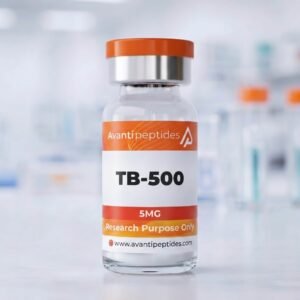
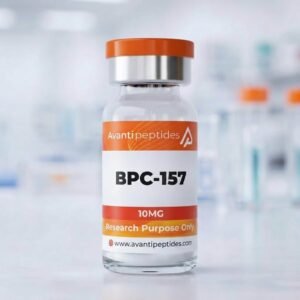
The Wolverine Stack pairs one vial of TB-500 5mg with one vial of BPC-157 5mg — two of the most frequently co-studied research peptides in soft-tissue and recovery-pathway literature. TB-500 is the acetylated seven-residue actin-binding fragment of thymosin beta-4; BPC-157 is a 15-amino-acid pentadecapeptide originally identified in human gastric juice. Buying both together as the Wolverine Stack saves you placing two separate orders when a protocol calls for both compounds.
What’s included
-
1×
TB-500 5mgPeptide fragment (Thymosin Beta-4 actin-binding domain) — lyophilised vial, ≥99% HPLC purity. -
1×
BPC-157 5mgSynthetic pentadecapeptide (15-amino-acid) — lyophilised vial, ≥99% HPLC purity.
Key features of TB-500 5mg
- Peptide fragment (Thymosin Beta-4 actin-binding domain)
- Sequence: Ac-Leu-Lys-Lys-Thr-Glu-Thr-Gln (7 amino acids)
- Lyophilised solid — stable, easy to store, straightforward to reconstitute
- Unit size: 5 mg / vial
- Every batch released only after identity, purity, and appearance QC
Key features of BPC-157 5mg
- Synthetic pentadecapeptide (15-amino-acid)
- Sequence: Gly-Glu-Pro-Pro-Pro-Gly-Lys-Pro-Ala-Asp-Asp-Ala-Gly-Leu-Val (15 amino acids)
- Lyophilised solid — stable, easy to store, straightforward to reconstitute
- Unit size: 5 mg / vial
- Every batch released only after identity, purity, and appearance QC
TB-500 5mg technical specifications
| Product name | TB-500 |
| Synonyms | Thymosin Beta-4 fragment; Tβ4(17-23); TB4 actin-binding domain fragment |
| Amino-acid sequence | Ac-Leu-Lys-Lys-Thr-Glu-Thr-Gln |
| Class | Peptide fragment (Thymosin Beta-4 actin-binding domain) |
| Molecular formula | C₃₁H₅₂N₆O₁₁ (free base) |
| Molecular weight | ~684.8 g/mol |
| CAS number | 885340-08-9 |
| Purity | ≥99% (HPLC) |
| Physical form | Lyophilised powder |
| Appearance | White to off-white solid |
| Unit size | 5 mg / vial |
| Note | This is the 7-residue active fragment, not full-length 43-amino-acid thymosin beta-4 |
BPC-157 5mg technical specifications
| Product name | BPC-157 |
| Synonyms | Body Protective Compound-157; Bepecin; PL-14736 |
| Amino-acid sequence | Gly-Glu-Pro-Pro-Pro-Gly-Lys-Pro-Ala-Asp-Asp-Ala-Gly-Leu-Val |
| Class | Synthetic pentadecapeptide (15-amino-acid) |
| Molecular formula | C₆₂H₉₈N₁₆O₂₂ (free base) |
| Molecular weight | ~1,419.5 g/mol |
| CAS number | 137525-51-0 |
| Purity | ≥99% (HPLC) |
| Physical form | Lyophilised powder |
| Appearance | White to off-white solid |
| Unit size | 5 mg / vial |
Reconstituting and storing your Wolverine Stack
Both vials follow the same reconstitution and storage protocol:
- Before reconstitution: Store both lyophilised vials at 2–8 °C, protected from light and moisture.
- Equilibrate: Allow each vial and diluent to reach room temperature before opening.
- Reconstitute: Add Bacteriostatic Water (10 ml recommended per vial). Swirl gently — do not vortex.
- After reconstitution: Store at 2–8 °C. Prepare aliquots to minimise freeze–thaw cycles.
- Compatibility: Use only within protocols that comply with your institution’s SOPs and local regulations.
Looking for complementary materials? See GHK-Cu 50mg — a complementary matrix-biology reagent.
The Wolverine Stack in research
TB-500 and BPC-157 are frequently studied alongside each other because they probe adjacent but distinct pathways relevant to soft-tissue and recovery-pathway research. The LKKTETQ motif in TB-500 is the region of Tβ4 that binds G-actin, giving researchers a focused probe of actin-sequestration and cell-migration biology. BPC-157’s defined pentadecapeptide structure is used to investigate cell survival, extracellular-matrix dynamics, and angiogenic signalling in the same class of in-vitro model systems. Stacking the two lets a single protocol interrogate cytoskeletal and matrix-signalling readouts side by side without sourcing from two separate suppliers.
Synthesis and quality assurance
Avanti Peptides manufactures both TB-500 and BPC-157 via controlled, validated solid-phase peptide synthesis (SPPS) to deliver high purity and lot-to-lot consistency. Each batch of each compound undergoes independent identity verification, HPLC purity analysis (≥99%), and appearance inspection before release — so the two vials in your Wolverine Stack carry their own, separately documented CoAs.